Air Defense
Phalanx CIWS
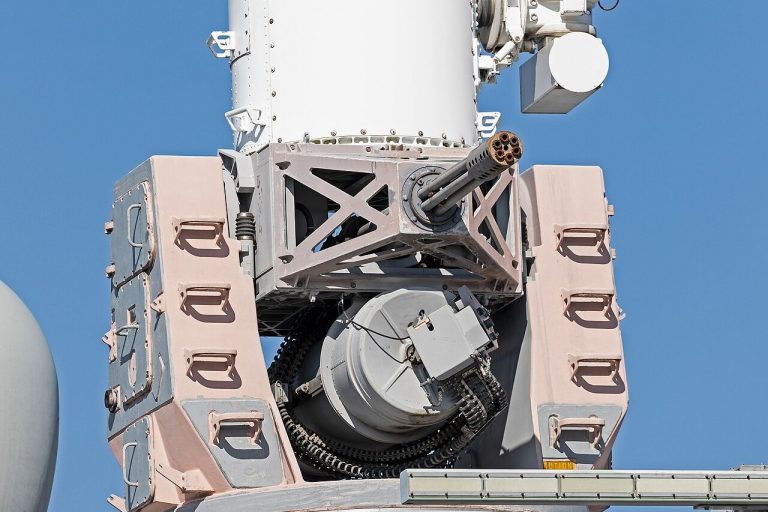
The Phalanx CIWS is an American close-in weapon system built by General Dynamics and later Raytheon, in service since 1980. Its six-barrel 20 mm Vulcan cannon fires up to 4,500 rounds a minute to defend ships against missiles, aircraft and small boats.
 United States|Raytheon (General Dynamics originally)
Overview
The Phalanx made its first shipboard test installation on USS Bigelow in 1973 and entered formal service in 1980 on USS Coontz. It combines a 20 mm M61A1 Vulcan gun with Ku-band search and track radar and a computer on one mount weighing about 6,200 kg (Block 1B). It fires 3,000 or 4,500 rounds a minute with tungsten penetrator ammunition and 1,550 rounds on board. Effective range is around 1.5 to 2 km, with a theoretical maximum of 3.6 km.
Block 1 appeared in 1988 and Block 1B, with FLIR for surface targets, in 1999. The Centurion C-RAM land version, introduced in 2004, defends bases against rockets and mortars. SeaRAM pairs the Phalanx sensors with an 11-round RIM-116 launcher. More than 25 navies use the Phalanx, including the US, UK, Japan, Australia, Canada, South Korea, Türkiye, Saudi Arabia, Egypt, the UAE, Qatar and Kuwait. A unit cost about 4.1 million dollars in the 2010s, and the system was reported in use against Houthi threats in the Red Sea in 2023 and 2024.
Key Specifications
Variants
The Phalanx Block 1B adds a forward-looking infrared sensor so the gun can engage small boats and surface targets.
SeaRAM combines the Phalanx sensors with an 11-round RIM-116 missile launcher.
The Centurion C-RAM is the land-based version that defends bases against rockets, artillery and mortars.
Operators
United States United Kingdom
 Japan
Japan Australia
 Canada
 South Korea
 Türkiye
 Saudi Arabia
 Egypt
Egypt UAE
UAE Qatar
Qatar Kuwait
 Bahrain
 Taiwan
 New Zealand
 Portugal
 Greece
 Pakistan
 Poland
 Morocco
 Oman
Oman Thailand
 Tunisia
 Chile
Chile Bulgaria
 Ecuador
 Indonesia
 Bangladesh
 Philippines
 Romania
Frequently Asked Questions
How fast does the Phalanx CIWS fire?
The Phalanx CIWS fires up to 4,500 rounds per minute from its six-barrel 20 mm M61A1 Vulcan cannon. Earlier versions fire 3,000 rounds a minute.
What is the range of the Phalanx CIWS?
The Phalanx CIWS has an effective range of around 1.5 to 2 km against missiles. Its theoretical maximum range is 3.6 km.
Phalanx vs Goalkeeper: which is better?
The Phalanx and the Goalkeeper both defend ships at close range. The Phalanx is lighter and uses a 20 mm gun, while the Dutch Goalkeeper uses a heavier 30 mm cannon with a shorter list of users.
How much does a Phalanx CIWS cost?
A Phalanx CIWS cost about 4.1 million US dollars per unit in the 2010s, according to estimates based on US Navy contract data.
Which countries use the Phalanx CIWS?
More than 25 navies use the Phalanx, including the US, UK, Japan, Australia, Canada, South Korea, Türkiye, Saudi Arabia, Egypt, the UAE, Qatar and Kuwait.
Which Arab countries have the Phalanx?
Saudi Arabia, Egypt, the UAE, Kuwait, Qatar, Bahrain and Oman have Phalanx systems on their ships.