

Utility Helicopter
Mi-26 Halo
The Mil Mi-26 (NATO: Halo) is a Russian heavy-lift helicopter built by Rostvertol in Rostov-on-Don, in service since 1983. It is the heaviest and most powerful helicopter in series production, able to carry about 20 t of payload.
 Russia|Rostvertol (Mil Moscow Helicopter Plant)
What Is the Mi-26 Halo? Overview, History and Development
The Mi-26 first flew on 14 December 1977 and entered Soviet service in 1983. It has an eight-blade rotor 32 m wide, two D-136 turboshafts of 11,400 shp each, and a maximum takeoff weight of 56,000 kg. It reaches about 295 km/h with a range of about 800 km and can carry more than 80 troops or vehicles up to about 20 t. The Mil V-12 prototype was larger but never produced.
About 310 have been built, and Rostvertol continues production at a low rate. The modernised Mi-26T2V entered Russian service around 2019–2020. Operators include Russia, Ukraine, India, China, Algeria, Venezuela, Peru, Belarus and Kazakhstan. Mi-26s helped at Chernobyl in 1986 and are used for firefighting and Himalayan logistics. Russian and Ukrainian sources reported losses in the Ukraine war. A new Mi-26T2 costs about US$25–30 million.
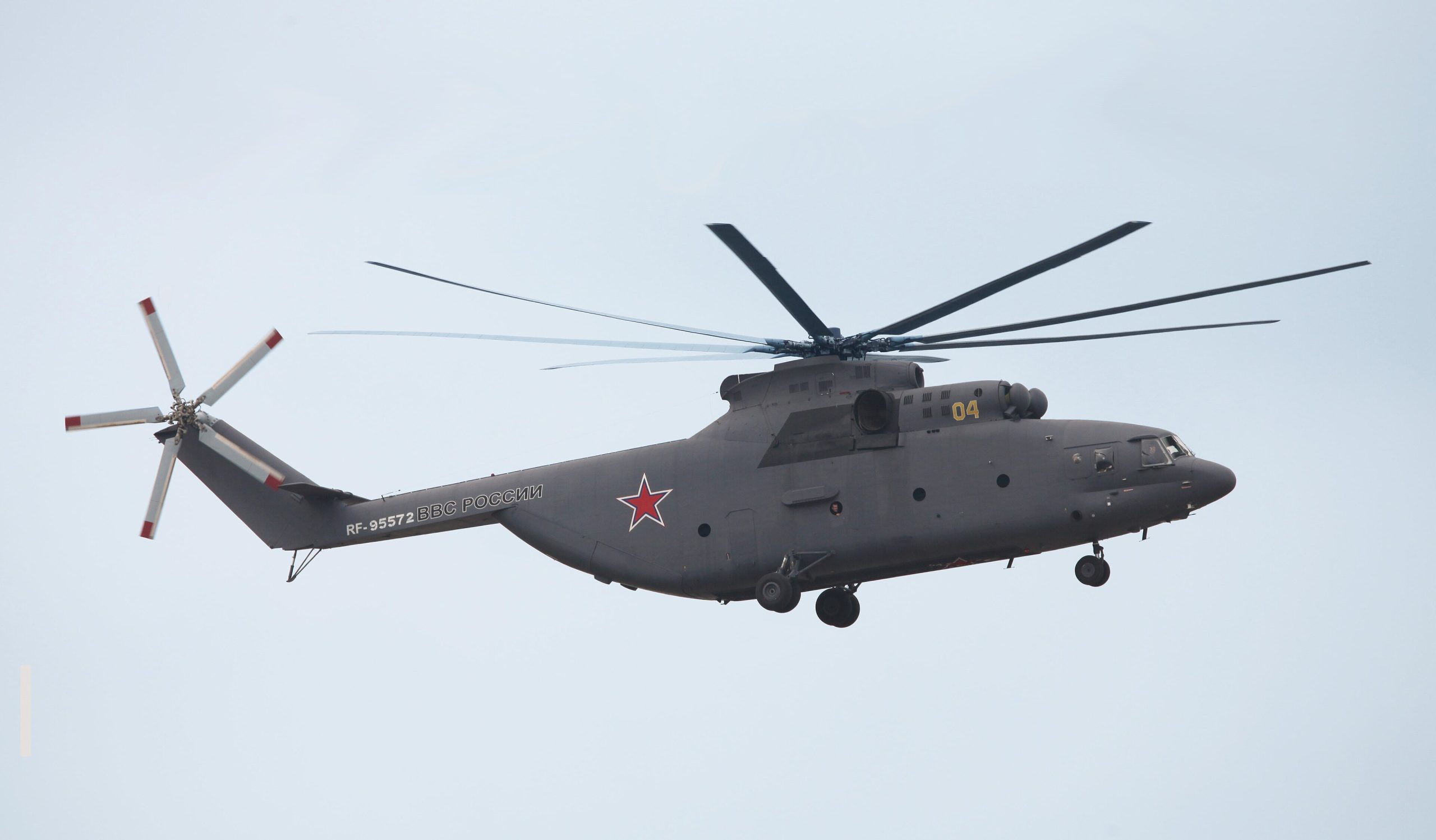
Mi-26 Halo Specifications: Speed, Range, Payload and Armament
Mi-26 Halo Variants and Versions Compared
The baseline heavy-lift version, with 20 t maximum payload, in service since 1983.
A modernised version with a digital cockpit, with the Mi-26T2V as the military variant.
The Russian military version with a glass cockpit, new avionics and a defensive suite, in service from about 2019–2020.
Which Countries Use the Mi-26 Halo? Operators and Users
Russia Ukraine
 India
India China
China Algeria
 Venezuela
 Peru
Peru Belarus
 Kazakhstan
Mi-26 Halo FAQ: Price, Range, Operators and Most Asked Questions
How much does the Mi-26 helicopter cost?
A new Mi-26T2 costs about US$25–30 million per helicopter, according to export estimates. Prices vary by customer and equipment, and Russia does not publish official unit costs.
How much can the Mi-26 carry?
The Mi-26 can carry a maximum payload of 20,000 kg, which includes armoured vehicles up to about 20 t or more than 80 troops. It has a cargo hold about 12 m long and a maximum takeoff weight of 56,000 kg.
Which countries use the Mi-26?
The Mi-26 is used by Russia, Ukraine, India, China, Algeria, Venezuela, Peru, Belarus and Kazakhstan. India’s Air Force has four, and Türkiye has no Mi-26 in military service.
Mi-26 vs CH-53K: which is better?
The Mi-26 carries more, with a payload of about 20 t against about 12.2 t sling load for the CH-53K. The CH-53K is a newer design with fly-by-wire controls, while the Mi-26 first flew in 1977.
Is the Mi-26 the biggest helicopter in the world?
The Mi-26 is the biggest helicopter in series production, with a maximum takeoff weight of 56,000 kg. The Mil V-12 prototype was larger but was never produced.
How fast is the Mi-26?
The Mi-26 has a maximum speed of about 295 km/h and a cruise speed of about 255 km/h. Its range is about 800 km on internal fuel, with a ferry range of about 1,920 km.