China’s J-20 Fighter Seen Carrying Eight External Missiles
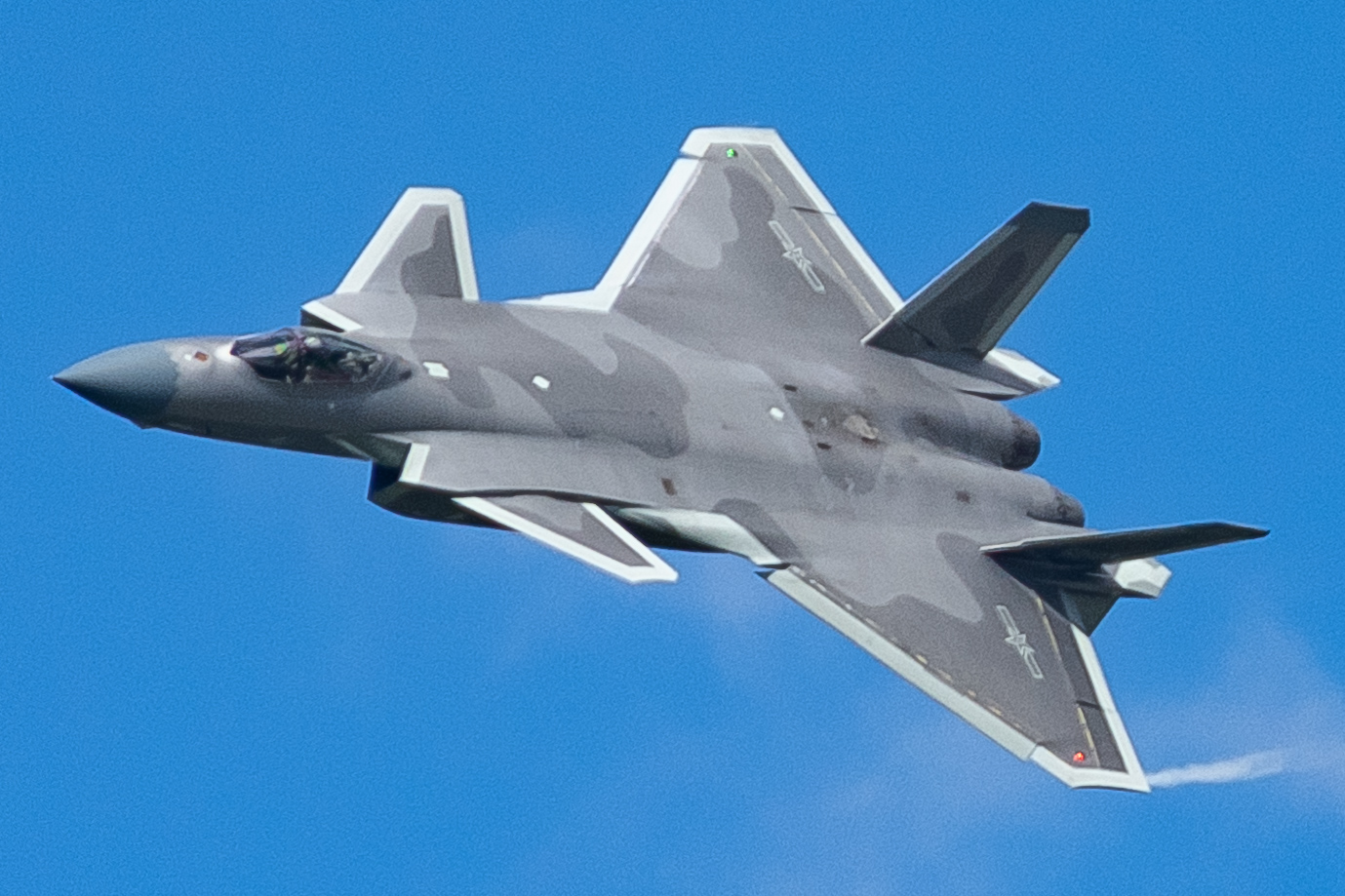
New footage circulating on Chinese social media since around November 4, 2026, shows a Chengdu J-20 stealth fighter carrying eight air-to-air missiles mounted externally on its underwing pylons, in addition to whatever load it may be carrying inside its weapons bays. The clearer-than-usual images, first analyzed and republished by Army Recognition, reignited debate over whether China’s only operational fifth-generation fighter is being evaluated for a high-capacity, reduced-stealth configuration that Western commentators have nicknamed “beast mode,” borrowing a term first used for similarly loaded F-35s and F-15EXs.
Beijing has not commented on the footage, the missile configuration, or the purpose of the flight. The images cannot by themselves confirm whether the aircraft is in operational service with this loadout, whether the missiles are live or inert test rounds, or what the internal bays were carrying at the time. What is new is the clarity of the imagery and the fact that similar sightings, dating back to at least February 2025, keep recurring, suggesting sustained testing rather than a one-off demonstration.
What Happened
The footage, reportedly shot on a mobile phone, shows a single J-20 with four underwing pylons, each apparently carrying two missiles resembling the PL-15 beyond-visual-range, active-radar-guided missile. That would put eight missiles on external stations alone. Analysts note the J-20’s internal bays can hold four more PL-15s in the main bay and two short-range, infrared-guided PL-10s in the side bays, for a theoretical maximum of 14 missiles if every station were filled — a figure some outlets have popularized but which the available imagery does not confirm for this specific aircraft.
Similar external-load imagery of J-20s has circulated periodically since 2025, and Chinese aviation media discussed underwing pylon adapters on J-20 test airframes as far back as 2020. The recurrence of the configuration across more than a year of sporadic sightings is itself the story: it points toward an ongoing evaluation program rather than a single publicity flight, though neither reading has been officially confirmed.
The Product: Chengdu J-20 “Mighty Dragon”
The J-20 is built by Chengdu Aircraft Corporation, a subsidiary of state-owned aviation conglomerate AVIC, and entered service with the People’s Liberation Army Air Force (PLAAF) in 2017. It is China’s first operational fifth-generation fighter, designed primarily for air superiority and long-range interception, with a secondary strike role. Early production aircraft relied on interim Russian AL-31F and later domestic WS-10C engines; Chinese state media and specialist outlets have reported since early 2026 that newer airframes, sometimes designated J-20A or J-20B, are transitioning to the domestically designed WS-15 engine, which Chinese sources claim offers greater thrust, though independent performance figures remain unverified.
Published fleet estimates vary widely and should be treated as approximate. The UK-based International Institute for Strategic Studies put the frontline force at roughly 150 aircraft in its 2023 assessment; more recent, less rigorously sourced estimates from specialist outlets range from around 270 to over 300, with occasional claims running higher still. No figure in this range has been independently verified by an official source, and Defense & Tech is not treating any single number as confirmed.
Who Uses It
The J-20 is flown exclusively by the PLAAF; it has not been exported, and China has not announced any export variant or customer. This distinguishes it from China’s export-oriented combat aircraft, such as the J-10C, which Pakistan operates and which Bangladesh is reportedly negotiating to buy. The J-20’s absence from any export catalogue is consistent with its role as China’s most sensitive airframe and its most direct answer to the US F-22 and F-35.
Why an External Load Matters
Mounting missiles externally increases an aircraft’s radar cross-section and aerodynamic drag compared with carrying them internally, undercutting the low-observable design that defines a stealth fighter in the first place. Analysts who reviewed the footage for Army Recognition and other specialist outlets suggest the configuration could be intended to test structural loads on dual-missile racks, wing stress under asymmetric or heavy loading, vibration, and safe weapons separation across different flight conditions — standard steps that typically precede any move toward operational use, armed or unarmed.
If the configuration were adopted operationally, the likely logic would be a split-role fleet: aircraft flying with a full internal load for genuinely stealthy penetration missions, and others accepting a larger radar signature in exchange for carrying more missiles on lower-threat missions such as standing air-defense patrols, long-range escort of bombers or tankers, or engagements where opposing radar and missile threats are assessed as lower. The same stealth-versus-firepower trade-off has already been debated publicly around the F-35, whose own external weapons stations allow a similar “beast mode” load when stealth is not required.
Global Competitors
The J-20 is one of a small number of fighters in or near operational fifth-generation status. The US F-22 Raptor and F-35 remain the benchmark for low-observable air combat aircraft, while Russia’s Su-57 has reached limited operational numbers and is being marketed for export, including to prospective buyers weighing it against China’s J-35. China itself is fielding the smaller, navalized J-35 alongside the J-20, giving the PLAAF and PLA Navy a two-type stealth fighter family that no other air force besides the United States currently matches. India’s own fifth-generation program, the AMCA, remains years from flight testing by comparison.
What Happens Next
Absent an official statement from the Ministry of National Defense or PLAAF, the configuration’s status will likely keep being inferred from intermittent, unofficial imagery rather than confirmed announcements, consistent with how China has handled previous J-20 development milestones, including the WS-15 engine transition. Analysts will be watching for whether future sightings show the same aircraft in both internal-only and mixed external-internal configurations, which would support the split-role theory, or whether the heavy external load appears only on what are identifiably trials or demonstrator airframes.
FAQ
Is the J-20’s stealth capability compromised by carrying external missiles?
Yes, in that specific configuration. Any aircraft carrying ordnance externally has a larger radar cross-section than when carrying the same weapons internally. Whether China intends to fly J-20s this way operationally, rather than only for testing, has not been confirmed.
How many missiles can the J-20 carry in total?
Its internal bays are generally described as holding four PL-15 and two PL-10 missiles. Adding eight external missiles, as shown in the recent footage, would bring a theoretical maximum to 14, though no official source has confirmed an aircraft flying with every station filled simultaneously.
Has China confirmed this is a new standard loadout?
No. Chinese authorities have not officially confirmed the footage, the missile configuration, or the purpose of the flight. Similar imagery has surfaced periodically since 2025 without an accompanying government statement.
Does any other country operate the J-20?
No. The J-20 has not been exported and flies only with the PLAAF. China’s export fighters, such as the J-10C and J-10CE, are separate, less sensitive airframes.
How many J-20s does China have in service?
Estimates vary considerably and are not officially confirmed. A 2023 assessment by the International Institute for Strategic Studies put the frontline fleet at roughly 150 aircraft; more recent unofficial estimates range from the high 200s to over 300.
Sources
- Army Recognition, “China’s J-20 Appears with Eight External Air-to-Air Missiles Highlighting Potential Expansion of Combat Capabilities,” November 6, 2026 — primary imagery analysis and timeline used for this report.
- Defence Security Asia, “China’s J-20 Shows Eight-Missile External Load, Highlighting Pacific Airpower Trade-Off,” November 2026 — corroborating analysis of the stealth/firepower trade-off.
- Zona Militar, “The first flight of a Chinese Air Force J-20 stealth fighter equipped with eight PL-15 air-to-air missiles has been recorded,” February 2025 — background on earlier sighting of the same external configuration.
- International Institute for Strategic Studies, Military Balance assessment cited via secondary reporting, 2023 — basis for the lower-bound PLAAF J-20 fleet estimate.