Baykar’s Bayraktar AKINCI: Turkey’s High-Altitude Hunter Reaches for Air Superiority


 React
React
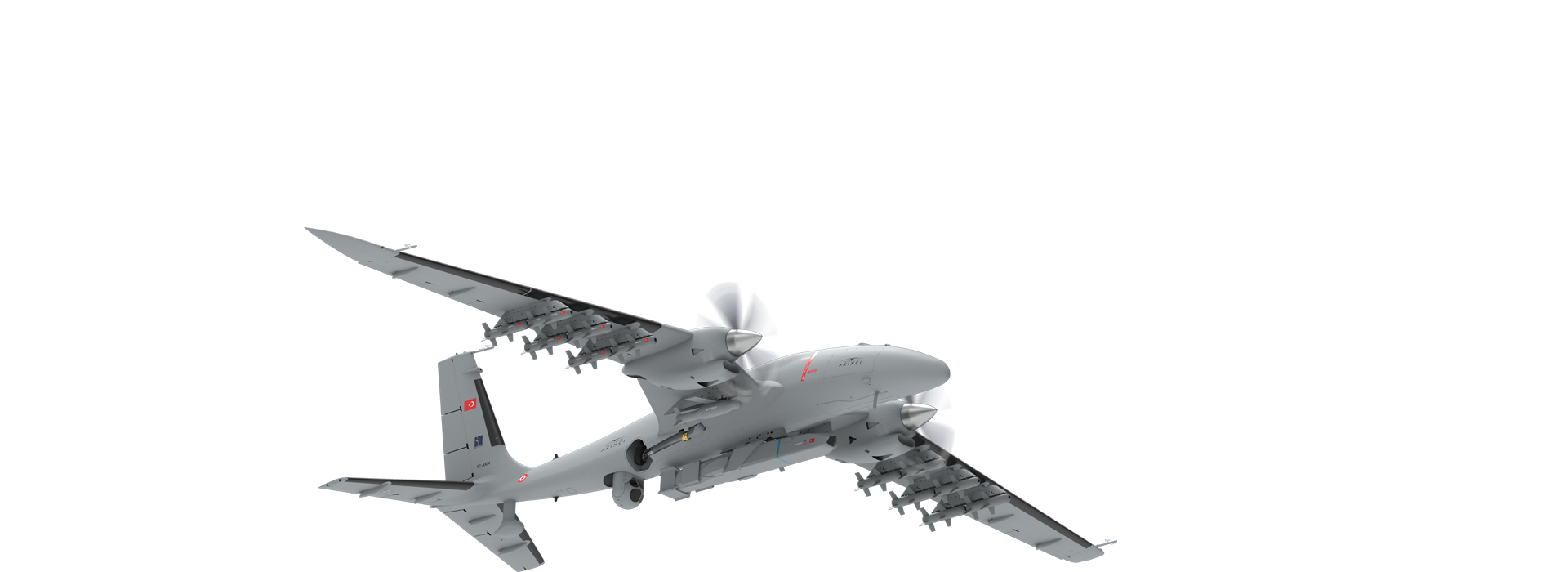
If TB2 put Turkey on the drone map, AKINCI is Baykar’s statement that it intends to stay — and move up. Weighing six metric tons at max takeoff and carrying 1,500 kg of weapons and sensors, AKINCI operates at altitudes and ranges that place it squarely in competition with the US MQ-9 Reaper, at a fraction of the acquisition cost.
| Specification | Value |
|---|---|
| Max Takeoff Weight | 6,000 kg |
| Payload Capacity | 1,500 kg |
| Endurance | 24+ hours |
| Operational Range | 6,000 km |
| Max Speed | 240 KTAS |
| Service Ceiling | 40,000 ft |
| Operating Altitude | 30,000 ft |
| Engines | Twin turboprop: 2×450 / 750 / 850 hp options |
| Wingspan | 20 m |
| Length | 12.3 m |
| Communication | SATCOM BLOS + triple-redundant LOS |
The Architecture of a Heavy Hitter
AKINCI’s development was announced in 2017 and first flew in 2019. Unlike TB2’s single reciprocating engine, AKINCI runs on twin turboprops configurable at 2×450 hp, 2×750 hp, or 2×850 hp depending on the mission profile. Three variants follow (AKINCI-A, -B, -C), each optimized for different sensor and strike configurations. The carbon-fiber airframe achieves a 20-meter wingspan and routinely clears 30,000 feet of operational altitude — the stratospheric territory of strategic ISR platforms.
Sensors That Do the Heavy Lifting
AKINCI’s headline feature is its multi-mode AESA radar — an Active Electronically Scanned Array that simultaneously detects and tracks aerial and ground targets. Combined with simultaneous EO/IR/laser designator optics and a SIGINT suite, the aircraft functions as a flying intelligence hub capable of striking whatever it finds without breaking orbit. The triple-redundant autopilot and SATCOM backbone keep the crew in the loop over a 6,000-km range envelope.
Air-to-Air: The Feature Nobody Saw Coming
Most UCAVs are strictly one-directional — they strike but cannot defend against airborne threats. AKINCI integrates air-to-air missiles, giving operators a self-defense option against light aerial threats without a fighter escort. Combined with cruise missiles for deep strikes and standoff weapons for defended targets, AKINCI blurs the line between a conventional UCAV and an unmanned combat aircraft operating in contested airspace.
Strategic Significance
The jump from TB2’s 700-kg MTOW to AKINCI’s 6,000-kg MTOW in roughly five years reflects both engineering ambition and compounding industrial investment. The Turkish Air Force has integrated AKINCI into strategic reconnaissance and deep-strike doctrine, while export interest signals that the platform could replicate TB2’s commercial success at the heavier end of the unmanned market.
React