
Milkor, Safran Sign MoU on Sensors for Milkor 380 UAV
Lead: South African drone maker Milkor and France’s Safran Electronics & Defense signed a memorandum of understanding at the Africa Aerospace and Defence (AAD) 2026 exhibition to integrate Safran optronics and navigation systems onto Milkor’s unmanned aircraft, starting with the medium-altitude, long-endurance Milkor 380 and extending to the larger Milkor 780 now in development. The deal pairs one of Africa’s few domestically designed combat drones with a French sensor and navigation specialist seeking a bigger foothold in the fast-growing unmanned systems export market.
What Happened
Milkor Group and Safran Electronics & Defense signed the MoU on the sidelines of AAD 2026, held September 16-20 at Air Force Base Waterkloof near Pretoria. The agreement was formalized by Julian Coetzee, CEO of Milkor, and Alexandre Ziegler, Director of the Defence Division at Safran Electronics & Defense, according to Military Africa and DefenceWeb, both of which covered the signing on site.
Under the MoU, the two companies will work to integrate Safran’s airborne optronics — visible and infrared cameras and gimballed sensor turrets — along with its position-navigation-timing (PNT) equipment, including inertial navigation units and GNSS receivers, onto Milkor’s unmanned aircraft. Ziegler said the partnership is designed to let “Safran’s optronic and navigation systems be integrated into drones exported by Milkor worldwide,” according to DefenceWeb’s report from the show floor. No contract value was disclosed, and the companies described the agreement as a framework for future integration work rather than a signed production order.
The Product/System
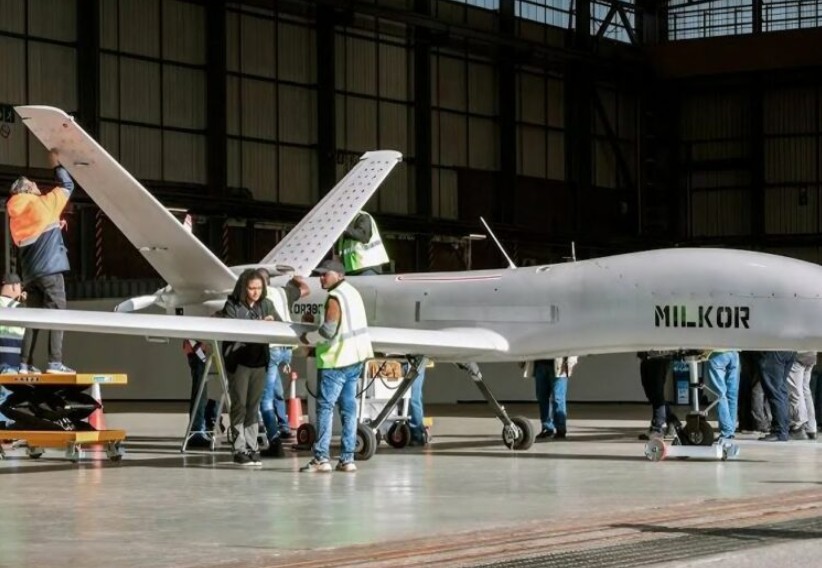
The initial integration target is the Milkor 380, a medium-altitude, long-endurance (MALE) unmanned aircraft already in low-rate production. Milkor describes it as the largest aircraft ever designed and built in Africa. Published specifications include an 18.6-meter wingspan, a 9-meter fuselage length, a maximum takeoff weight of roughly 1,500 kg, a payload capacity of about 220 kg, and endurance in the 30-to-35-hour range on a single Rotax 915 iS engine, with a stated range beyond 4,000 km and a service ceiling near 30,000 feet. The type first flew on September 19, 2023, and has since moved into serial production.
The MoU also covers Milkor’s follow-on design, the Milkor 780, a larger high-altitude, long-endurance platform still under development. Milkor has previously disclosed a 24-meter wingspan, a payload of roughly 2,700 kg spread across nine hardpoints, endurance of 30-40 hours, and a maximum range around 9,300 km — figures that, if realized, would put it in a similar performance class to established Chinese and Turkish strike-capable MALE/HALE platforms.
At AAD 2026, Milkor displayed a Milkor 380 airframe fitted with a synthetic-aperture radar pod, a Hensoldt Argos 15 electro-optical/infrared gimbal, an enhanced satellite-communications antenna, and two MBDA Sea Venom/ANL light anti-ship missiles — illustrating the sensor and weapons architecture the aircraft is designed to carry, though those specific systems are separate from the Safran optronics and navigation equipment covered by this MoU.
Who Uses It
The South African Air Force is the confirmed launch operator of the Milkor 380, having taken delivery of the type as it entered service from 2023 onward. Iraq is the aircraft’s first confirmed export customer: Baghdad signed a deal reported at around $12 million, and the first fleet of Milkor 380s was delivered in mid-2026, as previously reported by Defense & Tech. No other confirmed operators of the Milkor 380 have been publicly identified; any additional customers should be treated as unconfirmed until officially announced.
Export/Procurement History
Milkor has built its export case around offering a domestically manufactured MALE drone free of the end-user restrictions that accompany many U.S. and some European unmanned systems, positioning the 380 as an option for African and Middle Eastern buyers seeking armed ISR capability without the political conditions attached to Chinese or Russian platforms. According to DefenceWeb’s AAD 2026 coverage, Milkor is currently producing around eight airframes a year and has stated plans to roughly double that output during 2026 to meet both South African Air Force and export demand. The Safran MoU is Milkor’s latest industrial partnership as it works to standardize the 380’s sensor and navigation suite for a broader set of foreign customers; the company has separately partnered with Hensoldt for electro-optical payloads and with MBDA on the Sea Venom/ANL anti-ship missile integration shown at AAD 2026.
For Safran, the agreement extends a defense-electronics push built substantially through acquisitions — including Orolia, bought in 2022 for its positioning, navigation and timing technology, and radio-navigation specialist Syrlinks, acquired the same year — into the unmanned aircraft segment via a non-U.S., non-Chinese airframe partner.
Global Competitors
The Milkor 380 enters a MALE/HALE drone market in Africa increasingly shaped by Turkish and Chinese suppliers rather than Western ones. Turkish Bayraktar TB2 and Akıncı drones are already in service or on order with several African air forces, while Chinese CH-4 and Wing Loong II combat drones have been fielded by Chad, Ivory Coast and other states across the Sahel and West Africa. The U.S. MQ-9 Reaper remains the benchmark high-end MALE platform but is subject to tighter export controls that have limited its availability to African operators. Milkor’s pitch is to offer comparable ISR and light-strike performance to the TB2/CH-4 class, backed by African production and now, potentially, French-sourced optronics and navigation systems, rather than the fully Chinese- or Turkish-sourced sensor packages used by rival platforms.
Why It Matters
The MoU signals two parallel trends: South Africa’s push to re-establish itself as a credible unmanned-systems exporter after years of defense-industrial contraction, and Safran’s effort to diversify its defense-electronics customer base beyond traditional European and Gulf buyers into Africa’s fastest-growing arms segment. For African and Middle Eastern states wary of the political strings attached to Chinese, Russian or Turkish drone deals, a South African airframe integrating French sensors and navigation equipment offers a third procurement path — one that Milkor executives have said is central to the company’s export strategy, though its practical uptake still depends on customers beyond Iraq materializing.
What Happens Next
Neither company has published a timeline for when Safran-equipped Milkor 380s will fly or ship to customers, and no financial terms have been disclosed. The next milestones to watch are a follow-on supply or integration contract translating the MoU into hardware, further disclosure on Milkor 780 development progress, and any additional export announcements beyond Iraq at future air shows.
FAQ
What is the Milkor 380?
It is a South African-designed medium-altitude, long-endurance (MALE) unmanned aircraft built by Milkor, with an 18.6-meter wingspan, roughly 220 kg payload capacity and endurance of around 30-35 hours. It first flew in September 2023 and is now in production.
What did Milkor and Safran actually agree to?
A memorandum of understanding to integrate Safran’s airborne optronics (electro-optical/infrared cameras and gimbals) and position-navigation-timing systems onto Milkor’s UAVs, starting with the Milkor 380. It is a framework agreement, not a signed production contract, and no value has been disclosed.
Which countries currently operate the Milkor 380?
The South African Air Force is the confirmed launch operator, and Iraq is the first confirmed export customer, having received its first fleet of Milkor 380s in 2026. No other operators have been officially confirmed.
How does the Milkor 380 compare to the Bayraktar TB2 or MQ-9 Reaper?
The Milkor 380 sits closer to the Bayraktar TB2/CH-4 class in size and role than to the larger MQ-9 Reaper, but Milkor and its partners have shown weapons integration (including MBDA’s Sea Venom/ANL anti-ship missile) aimed at giving it a broader strike role than the TB2.
What is the Milkor 780?
It is Milkor’s larger, still-developmental follow-on design, with a reported 24-meter wingspan, around 2,700 kg payload across nine hardpoints, and up to 9,300 km range — a high-altitude, long-endurance platform also covered by the Safran MoU.
Sources
- Military Africa, “AAD 2026: Milkor and Safran sign MoU to boost tactical UAV capabilities,” September 27, 2026 — military.africa — primary report on the signing and signatories.
- DefenceWeb, “Milkor and Safran sign MoU on optronics and navigation integration for UAVs,” September 2026 — defenceweb.co.za — official quote from Safran’s Alexandre Ziegler and AAD 2026 display details.
- DefenceWeb, “Milkor promotes 380 UAV as it continues development of larger 780,” 2026 — defenceweb.co.za — Milkor 380/780 specifications and production rate.
- Wikipedia, “Milkor 380” — en.wikipedia.org — airframe specifications and first-flight date, cross-checked against manufacturer and press reporting.
- Defense & Tech, “Iraq’s $12 Million Drone Deal: First Fleet of South African Milkor 380s Arrives This Week,” May 2026 — defenseandtech.com — background on Milkor 380’s first confirmed export customer.