Kongsberg Unveils Arctic Hunter USV for Royal Navy Type 92 Submarine Hunting
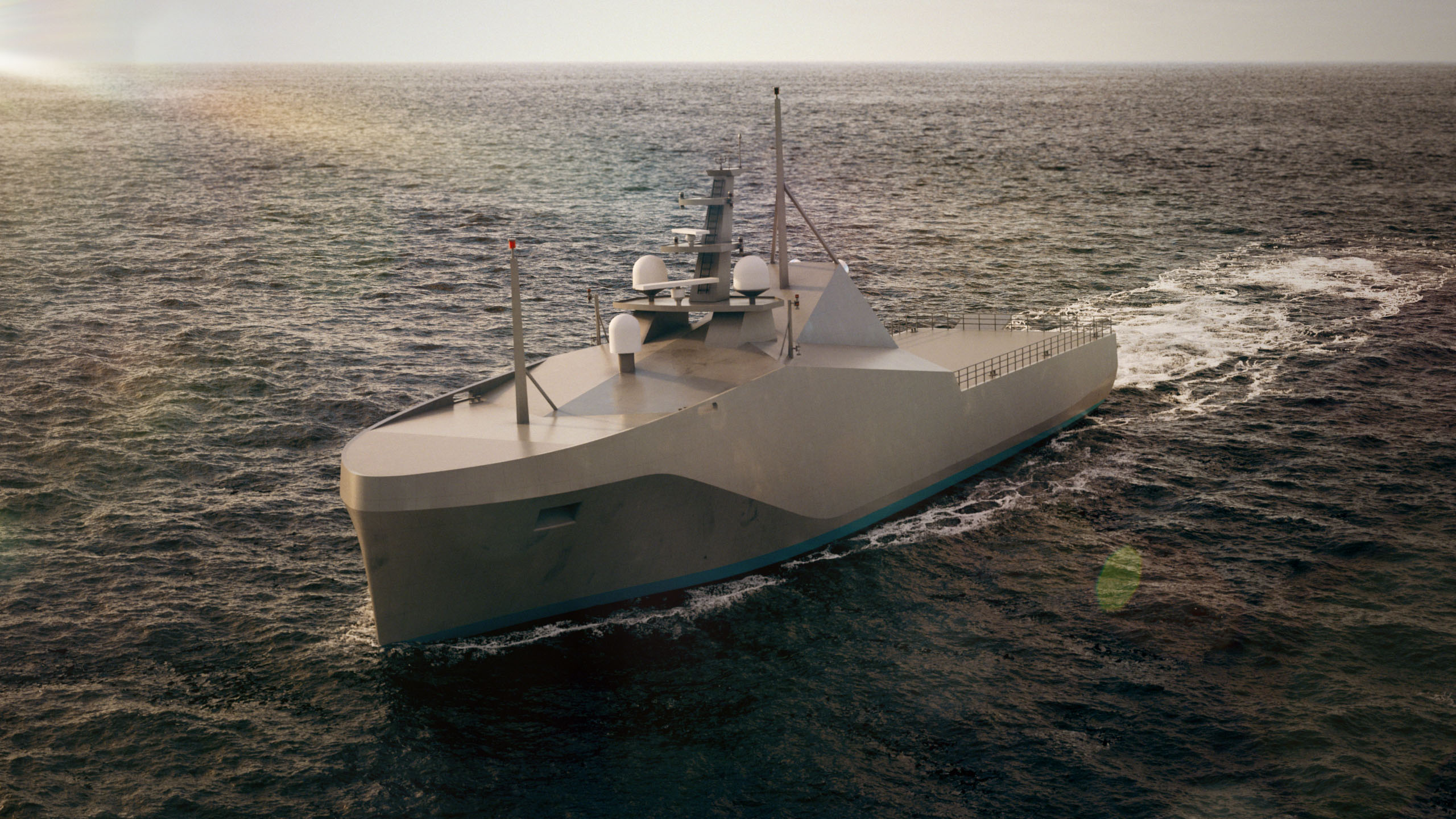
Kongsberg Maritime has unveiled the Arctic Hunter, an uncrewed surface vessel built on one of its Arctic commercial ship designs, as its bid for the Royal Navy’s Type 92 anti-submarine warfare requirement. The Norwegian company announced the design in Oslo on November 9, ahead of the Atlantic Future Forum.
The vessel would carry Thales UK sonar and communications and be built by Balaena Maritime at Birkenhead. No contract has been awarded; Type 92 was first set out in the UK Defence Investment Plan in June 2026.
Arctic Hunter USV Design and Sensors
Kongsberg describes Arctic Hunter as a remotely operated vessel with autonomous functions. According to The War Zone, it uses an existing 184-foot Arctic trawler hull form, with the wheelhouse and fish-processing factory removed to make room for mission systems and remote-operation equipment.
The company said the vessel has enough payload capacity and deck space to take other mission systems over its life. It would operate from a forward base inside the Arctic Circle. Kongsberg said its uncrewed vessel technology already holds flag-state approval from DNV and the Norwegian Maritime Authority.
| Item | Detail |
|---|---|
| Designer | Kongsberg Maritime (Norway) |
| Type | Uncrewed surface vessel, remotely operated with autonomous functions |
| Hull | Existing 184-ft Arctic trawler hull form |
| Endurance | Missions of up to 60 days (design goal) |
| Mission systems | Thales UK sonar and secure military communications |
| Builder | Balaena Maritime, Birkenhead (planned) |
| Target requirement | Royal Navy Type 92 ASW |
| Status | Proposal; not in build, no contract awarded |
The War Zone reported that the design is built around Thales’s Sonar 2087 towed array, fitted to Type 23 frigates and planned for Type 26. Kongsberg’s Reach Remote vessels run for about 30 days at a time, so the 60-day target doubles that.
Thales and Balaena Join the Type 92 Bid
Naval News reported on November 10 that Thales and Kongsberg had signed a memorandum of understanding to develop anti-submarine sensing for Type 92. Thales UK will contribute sonar technology, secure communications, its cortAix AI accelerator and planning tools. Kongsberg said it would also sign technology collaboration agreements with Thales UK and Balaena Maritime.
“Atlantic security is an absolute priority,” said Lisa Edvardsen Haugan, chief executive of Kongsberg Maritime. Bruce Balchin, a senior naval consultant at the company, told Naval News that Kongsberg is “responding to the RN’s demand signal for Type 92 capability, as the priority ‘hybrid navy’ asset.” Kongsberg said ships could be ready for deployment by the end of the decade.
Where Type 92 Fits in the Hybrid Navy
Type 92 is one of four uncrewed types in the Royal Navy’s hybrid navy plan. Janes describes it as an uncrewed “ASW sloop” central to Atlantic Bastion, the concept for protecting the deterrent and undersea infrastructure in the North Atlantic.
| Type | Role | Operating concept |
|---|---|---|
| Type 91 | Uncrewed missile platform | Atlantic Shield and Atlantic Strike |
| Type 92 | Uncrewed ASW sensing vessel | Atlantic Bastion |
| Type 93 | Extra-large uncrewed underwater vehicle | Atlantic Bastion |
| Type 94 | Uncrewed radar platform | Atlantic Shield |
The wider programme moved the same week. The Royal Navy commissioned its 1st Autonomous Squadron at Portsmouth on November 5, with about 180 personnel operating Kraken and Rattler boats. On November 10 the UK announced a framework with Ocean Infinity Solutions for Atlantic Net, the first sensing layer of Atlantic Bastion, which it said would lead to £90 million of investment. Commercially run undersea surveillance of this kind echoes Sweden’s Baltic deal with Saildrone.
Arctic Hunter vs Sea Hunter
The closest documented comparison is the US Sea Hunter, a purpose-built ASW drone ship from DARPA’s ACTUV programme.
| Feature | Arctic Hunter | Sea Hunter |
|---|---|---|
| Developer | Kongsberg Maritime | Leidos, for DARPA ACTUV |
| Hull origin | Adapted Arctic trawler design | Purpose-built uncrewed vessel |
| Length | 184 ft (about 56 m) | 132 ft (40 m) |
| Endurance | Up to 60 days (design) | 30 to 90 days without resupply |
| Top speed | Not disclosed | 27 knots |
| Status | Proposed for Type 92 | Christened April 2016, in service |
Kongsberg Maritime Company Profile
Kongsberg Maritime was demerged from Kongsberg Gruppen and listed in Oslo on April 23, 2026. Kongsberg Gruppen kept the defence and aerospace business.
| Item | Detail |
|---|---|
| Headquarters | Kongsberg, Norway |
| Founded | Roots in Kongsberg Våpenfabrikk (1814); listed separately as Kongsberg Maritime ASA in April 2026 (ticker KMAR) |
| Employees | More than 8,300 in 35 countries (2026) |
| Revenue | NOK 27,123 million (2025, as a Kongsberg Gruppen business area) |
| CEO | Lisa Edvardsen Haugan |
| Segments | Ship design and propulsion, vessel systems, digital solutions, lifecycle services |
| Known programmes | Reach Remote uncrewed vessels, Type 23 and Type 26 propeller work, Arctic Hunter |
A Trawler Hull for the High North
Balchin summed up the idea as replacing “towing fish with towing sonar.” He called the initial concept as a “minimum viable capability,” with a later stage of “Type 26 at the core, and these acting as autonomous wingmen.” Kongsberg argues commercial yards can build the ships at pace while defence firms integrate the military kit.
The bet is on mass and endurance. A proven fishing hull with a towed array could put more sonar in the water than frigates alone. That reading is analysis, not a company claim; no unit cost has been published. In April 2026 the UK and Norway disclosed a month-long operation to track a Russian Akula-class submarine near North Atlantic undersea infrastructure. Our explainer on how anti-submarine warfare works covers why towed arrays matter.
Arctic Hunter and Type 92 FAQ
What is the Arctic Hunter USV?
A Kongsberg Maritime uncrewed vessel, adapted from an Arctic trawler design, for anti-submarine warfare in the High North.
What is the Royal Navy Type 92?
An uncrewed ASW sensing vessel in the UK hybrid navy plan, part of the Atlantic Bastion concept.
Has the Royal Navy ordered Arctic Hunter?
No. It is a company proposal, and no contract has been awarded.
How long can Arctic Hunter stay at sea?
Kongsberg says it is designed for missions of up to 60 days.
- Kongsberg Maritime – “Kongsberg Maritime launches Arctic Hunter USV for the Hybrid Navy” (press release, November 9, 2026): mynewsdesk.com
- Naval News – “Kongsberg Maritime launches Arctic Hunter USV for the Hybrid Navy” (November 9, 2026): navalnews.com
- Naval News – Thales and Kongsberg Type 92 USV ASW memorandum (November 10, 2026): navalnews.com
- Naval News – 1st Autonomous Squadron; Atlantic Net (November 2026)
- The War Zone; Janes (November 2026)
- Kongsberg Maritime and Euronext listing releases; Kongsberg Q4 2025 results; Wikipedia – Sea Hunter