DRDO Signs First Deep-Tech Pact for Indigenous Quantum Refrigerator
DRDO Signs First Deep-Tech Pact for Indigenous Quantum Refrigerator
India’s Defence Research and Development Organisation (DRDO) has signed its first high-value project agreement under the Technology Development Fund (TDF) scheme, contracting Alwar-based startup Zero mK India Private Limited to design and build an indigenous 20 millikelvin (mK) dilution refrigerator. The deal, confirmed in a Press Information Bureau release and reported by Indian defense and technology outlets on September 25-27, 2026, targets a category of ultra-low-temperature hardware that India’s quantum computing and quantum-sensing programs have so far had to import, mostly from Finnish and British suppliers.
What Happened
DRDO executed the agreement with Zero mK India under the expanded ₹500 crore (roughly $52 million) TDF corpus that Defence Minister Rajnath Singh approved for deep-tech and cutting-edge projects. Officials described it as the fund’s first high-value deep-tech award to a startup, marking a shift in how DRDO is trying to build strategic hardware capacity through industry rather than solely through in-house laboratories. The project will be monitored and technically evaluated by scientists at DRDO’s Solid State Physics Laboratory (SSPL) in Delhi, which has been designated as the mentoring lab for the effort.
Neither DRDO nor Zero mK India has published a delivery timeline, a unit cost, or the value of the specific contract carved out of the TDF corpus, and this has not been independently confirmed beyond the PIB release and its syndication across Indian outlets. No Western defense-media outlet had reported on the agreement as of publication.
The Product/System
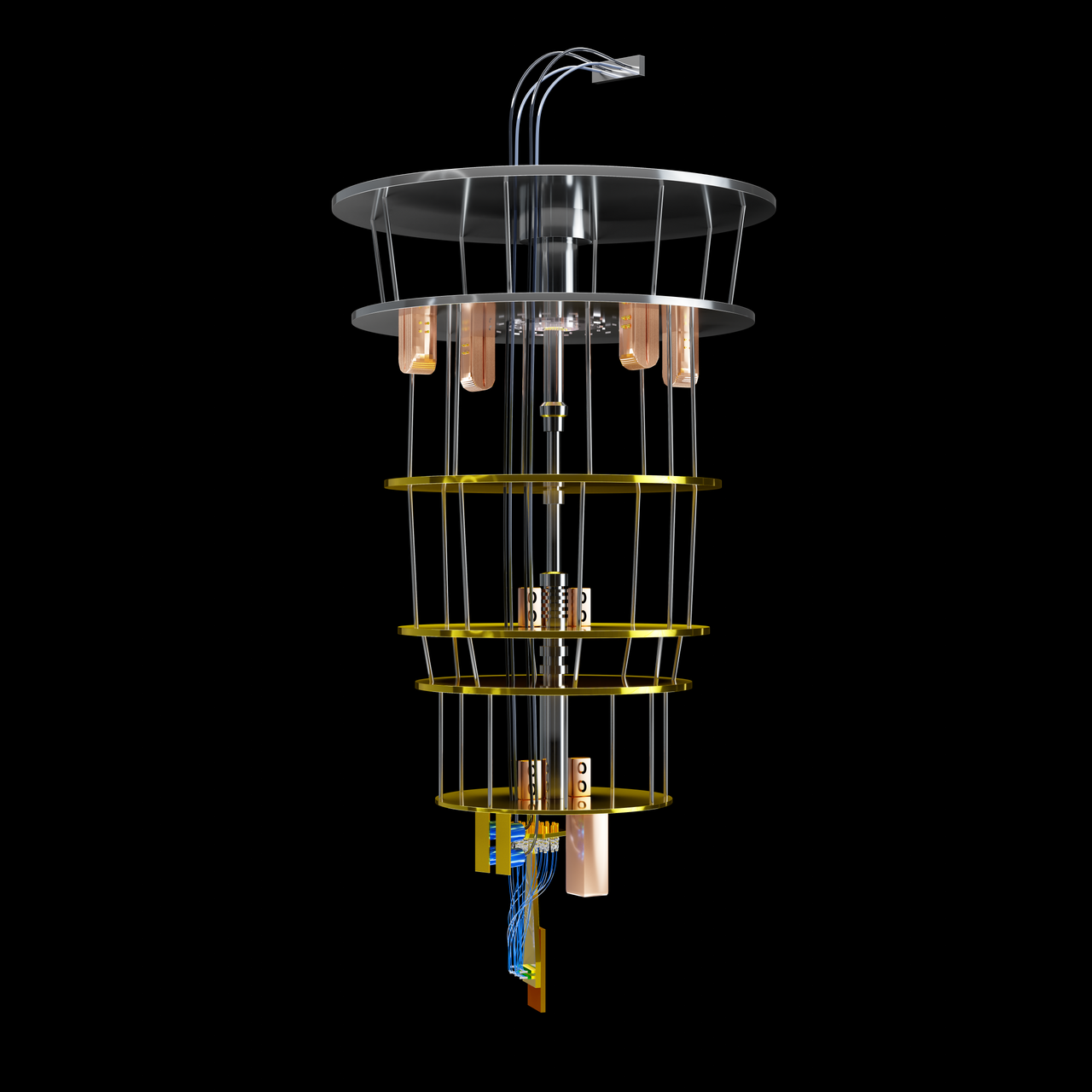
A dilution refrigerator is a specialized cryostat that uses a circulating mixture of helium-3 and helium-4 isotopes to reach temperatures a fraction of a degree above absolute zero. The 20 mK class DRDO is funding sits deep enough to preserve the fragile quantum coherence that solid-state quantum processors depend on, including superconducting qubit circuits, silicon spin qubits, and quantum sensing arrays used for magnetometry and precision timing.
Without such a system operating reliably at that temperature band, a quantum processor’s qubits decohere and cannot hold or process quantum information. Every national quantum computing effort therefore depends on a small pool of cryogenic-engineering firms capable of building and servicing these machines, which is precisely the dependency DRDO is trying to reduce.
Who Is Involved
Zero mK India Private Limited is a Rajasthan-based startup that, according to Indian trade press, is taking on the engineering and fabrication of the refrigerator itself. Public reporting on its founders and prior track record in cryogenic engineering remains thin, and Defense & Tech was unable to independently verify company leadership details beyond press mentions; that should be read as a gap in available reporting rather than a confirmed fact.
On the DRDO side, SSPL Delhi is the named technical authority. The lab already houses the DRDO Quantum Technology Research Centre, inaugurated in 2025 to develop quantum key distribution for secure communications, atomic clocks for navigation in GPS-denied environments, and atomic magnetometers for sensing — all programs that would draw on domestically built cryogenic infrastructure once it exists.
Program History and Funding
The TDF scheme was created under DRDO to advance self-reliance in defense technology as part of the Make in India initiative, with a particular mandate to draw in MSMEs and startups rather than only established defense contractors. It is implemented through the Global Innovation & Technology Alliance (GITA), a public-private body backed by the Technology Development Board, the Department of Science & Technology, and the Confederation of Indian Industry.
The Zero mK India agreement is described as the first high-value project drawn from the fund’s recently expanded ₹500 crore corpus, positioning it as a marker for how DRDO intends to route future deep-tech awards through the TDF mechanism rather than exclusively through its own laboratories or larger public-sector contractors like Bharat Electronics or Bharat Dynamics.
Global Competitors
The dilution refrigerator market is dominated by a small number of foreign manufacturers. Finland’s Bluefors and the UK’s Oxford Instruments NanoScience together account for more than 70 percent of global revenue in the category, a duopoly built over more than a decade of supplying university and corporate quantum computing labs. A second tier of suppliers includes the Netherlands’ Leiden Cryogenics, Air Liquide’s Cryoconcept unit, and several Japanese and American vendors.
That concentration means most countries running national quantum computing programs, India included, have relied on importing this equipment. China has invested heavily in domestic cryogenic manufacturing for its own quantum program, and the DRDO-Zero mK India project puts India on a similar path, though starting from a considerably smaller industrial base in this specific niche.
Why It Matters
Cryogenic hardware capable of reaching millikelvin temperatures is a chokepoint technology: it sits underneath quantum computing, secure quantum communications, and advanced sensing programs that have direct defense applications, from post-quantum-safe cryptography to precision navigation in environments where satellite navigation is jammed or denied. A country that cannot build or maintain its own dilution refrigerators is dependent on foreign suppliers for a component that underpins those capabilities, creating a potential supply-chain vulnerability in a strategic technology area.
For DRDO, funding a startup rather than building the capability entirely in-house also signals an approach to deep-tech acquisition that leans more on India’s private technology sector, consistent with the broader push described by India’s Defence Secretary to have DRDO narrow its own project list and hand a larger production role to industry.
What Happens Next
Public reporting has not disclosed a target delivery date for the 20 mK refrigerator, and DRDO has not said whether the resulting design will be adopted directly by the Quantum Technology Research Centre or offered more broadly to India’s wider quantum computing ecosystem, including the National Quantum Mission’s other funded labs. Given the early stage of the project, further DRDO statements or a demonstration unit would be the next concrete indicators of progress, rather than any near-term operational deployment.
FAQ
What is a dilution refrigerator used for?
It cools quantum processors and sensors to within a fraction of a degree of absolute zero, the temperature range needed to keep qubits and other quantum devices in a coherent, usable state.
Why does DRDO need an indigenous dilution refrigerator?
India currently imports this class of cryogenic hardware, mainly from Finnish and British suppliers. An indigenous version would reduce that import dependency for equipment that underpins quantum computing, secure communications, and sensing programs with defense applications.
What is the DRDO Technology Development Fund (TDF)?
It is a DRDO-run funding scheme, implemented through the Global Innovation & Technology Alliance, aimed at building defense-relevant technology capability in Indian industry, with an emphasis on startups and MSMEs rather than established defense contractors alone.
Who is building the refrigerator?
Zero mK India Private Limited, a startup based in Alwar, Rajasthan, under technical mentorship and evaluation from DRDO’s Solid State Physics Laboratory in Delhi.
Is this related to India’s National Quantum Mission?
DRDO has framed the project as aligned with the National Quantum Mission’s goals, though the TDF agreement itself is a separate, DRDO-specific contract rather than a National Quantum Mission award.
Sources
- Press Information Bureau, Government of India, “DRDO inks first high-value deep tech project agreement with a start-up under TDF scheme for indigenous development of 20 mK Dilution Refrigerator for Quantum Applications,” September 2026 — official government confirmation of the agreement. (pib.gov.in)
- Quantum Computing Report, “DRDO Signs First High-Value TDF Pact with Startup Zero mK India for 20 mK Dilution Refrigerator,” September 25, 2026 — technical detail on the refrigerator’s specifications and SSPL’s oversight role. (quantumcomputingreport.com)
- Manorama Yearbook, “What is Technology Development Fund (TDF) scheme of DRDO?,” September 25, 2026 — background on the TDF scheme’s structure and GITA’s role as implementing partner. (manoramayearbook.in)
- IBTimes India, “DRDO partners with startup to develop 20 mK-class dilution refrigerator,” September 2026 — additional confirmation of project scope. (ibtimes.co.in)
- Press Information Bureau, Government of India, “DRDO inaugurates Quantum Technology Research Centre,” May 2025 — background on DRDO’s existing quantum research infrastructure at SSPL Delhi. (pib.gov.in)
- Yahoo Finance / GlobeNewswire, “Following Bluefors and Oxford Instruments’ Expansion of Millikelvin Dilution Refrigerators, New Study Maps Growth Vectors in Quantum Cryogenic Infrastructure,” August 17, 2026 — market-share data on global dilution refrigerator suppliers.