

What is the “Dark Eagle”? And What Does U.S. Deployment Mean for the Middle East?

WASHINGTON — In the rapidly escalating shadow war between the United States and Iran, a new and terrifying name has entered the tactical lexicon: the Dark Eagle.
Following reports that U.S. Central Command (CENTCOM) has formally requested the deployment of this highly classified system to the Middle East, military analysts are scrambling to assess the fallout. But to understand the geopolitical shockwave this deployment would cause, one must first understand the weapon itself.
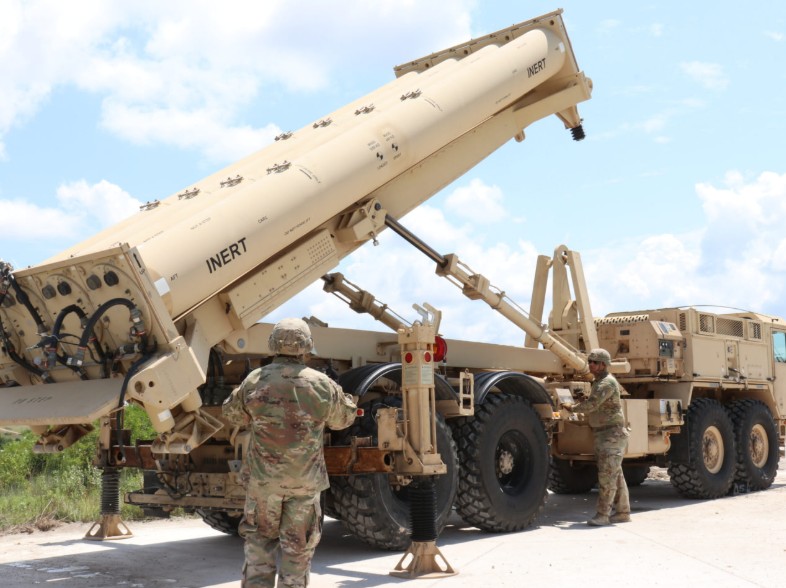
What is the “Dark Eagle”?
Officially designated as the Long-Range Hypersonic Weapon (LRHW), the Dark Eagle is a joint U.S. Army and Navy project representing the pinnacle of modern kinetic strike capability. It is not a standard ballistic or cruise missile; it is a paradigm shift in aerospace engineering.
1. Unprecedented Speed: The Dark Eagle operates at hypersonic velocities, meaning it travels at speeds exceeding Mach 5 (roughly 3,800 mph or 6,100 km/h), though its true top speed remains classified. At this velocity, the friction of the atmosphere creates a plasma sheath around the missile, an engineering hurdle that took decades to overcome.
2. The Hypersonic Glide Body (HGB): Unlike traditional intercontinental ballistic missiles (ICBMs) that travel in a predictable, parabolic arc into space and back down, the Dark Eagle uses a rocket motor to reach the upper atmosphere, whereupon it releases a Common Hypersonic Glide Body. This unpowered glide vehicle surfs the atmosphere toward its target.
3. Unpredictable Maneuverability: Because it does not follow a predictable ballistic trajectory, the glide body can maneuver dramatically mid-flight. It can change course, alter its altitude, and fly beneath the radar horizons of traditional early-warning systems.

What Does Deployment to the Region Mean?
Deploying a weapon with an estimated operational range of nearly 3,000 kilometers (1,860 miles) to the Middle East is not just a tactical adjustment; it is a fundamental rewriting of regional deterrence.
1. Nullifying Iran’s Geographic Depth: Historically, Iran’s primary defensive strategy has been its vast geography. Tehran has systematically buried its most critical nuclear sites, missile silos, and command centers deep within mountain ranges, far from its borders. Recently, the IRGC moved its missile launchers beyond the 483-kilometer range of the U.S. Precision Strike Missile (PrSM). The Dark Eagle renders that geographic depth irrelevant. From a secure base in the Persian Gulf or allied territory, CENTCOM could strike any target deep within the Iranian mainland within minutes.

2. Defeating Advanced Air Defenses: Current air and missile defense systems—whether U.S. Patriots or Russian S-400s—rely on calculating the predictable path of an incoming threat to launch an interceptor. Because the Dark Eagle maneuvers at Mach 5+, calculating an intercept point is mathematically nearly impossible for current generation systems. Its deployment means the U.S. possesses a guaranteed “first-strike” conventional capability that adversary defenses cannot stop.
3. The Ultimate Conventional Deterrent: Perhaps the most significant implication is psychological. The Dark Eagle provides Washington with a “prompt global strike” capability—the ability to destroy high-value, heavily fortified targets instantly without crossing the nuclear threshold.
If CENTCOM places the Dark Eagle on Middle Eastern soil, the message to Tehran is unequivocal: There is no bunker deep enough, no mountain thick enough, and no distance far enough to hide. It is the ultimate tool of coercive diplomacy, fundamentally altering the strategic calculus of the ongoing conflict.


