Mission Sudarshan Chakra Explained: India’s Plan for a National Air Defence Shield by 2035
On 15 August 2025, Prime Minister Narendra Modi used his Independence Day speech to announce one of India’s most ambitious defence goals: Mission Sudarshan Chakra, a national security shield to protect the country’s cities, military bases and critical sites by 2035. Often compared with Israel’s Iron Dome and America’s Golden Dome, it is a long-term programme rather than a single weapon.
- Announced by PM Narendra Modi on 15 August 2025
- Target date: a nationwide protective shield by 2035
- Combines sensors, interceptors, lasers and counter-strike capability
- Builds on S-400, Akash, MRSAM and the indigenous Project Kusha
- Shaped by the air defence experience of Operation Sindoor in May 2025
What is Mission Sudarshan Chakra?
The mission is named after the spinning discus weapon of Lord Krishna in Hindu tradition. Modi said it would protect strategic, civilian and religious sites from air threats and that it would not only neutralise attacks but also strike back. The plan is to build an integrated, layered network covering the whole country, developed largely in India.
Why now?
During Operation Sindoor in May 2025, India’s air defences faced waves of Pakistani drones, rockets and missiles. Systems such as the S-400, Akash, MRSAM and older guns, linked through the Indian Air Force’s Integrated Air Command and Control System (IACCS), performed well. That experience convinced the government that national-scale air defence had to become a long-term priority.
What will the shield include?
Mission Sudarshan Chakra is expected to bring several programmes under one umbrella. They include the ballistic missile defence system with its AD-1 and AD-2 interceptors, the planned Project Kusha long-range surface-to-air missile, QRSAM and very short-range systems, counter-drone networks and directed energy weapons. In August 2025 DRDO tested an Integrated Air Defence Weapon System combining QRSAM, VSHORADS missiles and a high-power laser.
Project Kusha and lasers
Project Kusha is DRDO’s effort to build an indigenous long-range air defence system with interceptors in roughly 150, 250 and 350 km classes, broadly comparable to the S-400. India has also demonstrated a 30 kW laser weapon able to destroy drones, part of a push towards cheaper ways of defeating mass drone attacks.
The challenges
Covering a country the size of India is an enormous task. Experts point to the cost, the need for many more radars and satellites, the integration of Army, Navy and Air Force systems, and the risk of becoming dependent on foreign components. A full shield is unlikely before the mid-2030s, and priorities will focus first on major cities and strategic sites.
Verdict
Mission Sudarshan Chakra sets a clear political goal for Indian air defence and gives DRDO and industry a long-term roadmap. Its success will be measured less by a single new weapon than by whether India can connect sensors, shooters and command centres into one reliable network within a decade.
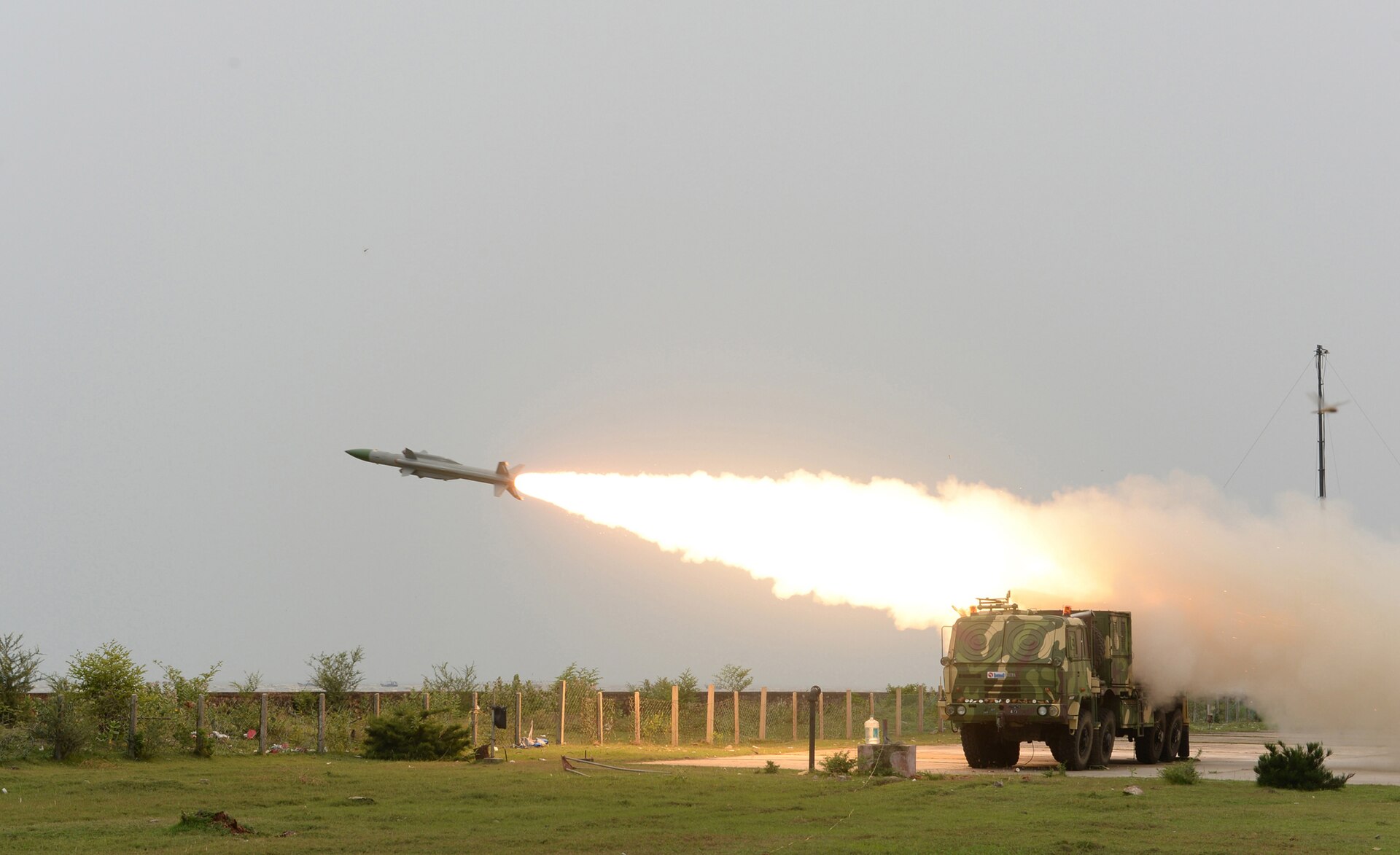
Featured image: Ministry of Defence, Government of India / GODL-India, via Wikimedia Commons