Agni-Prime Missile Explained: Range, Rail Launcher and India’s New-Generation Nuclear Missile
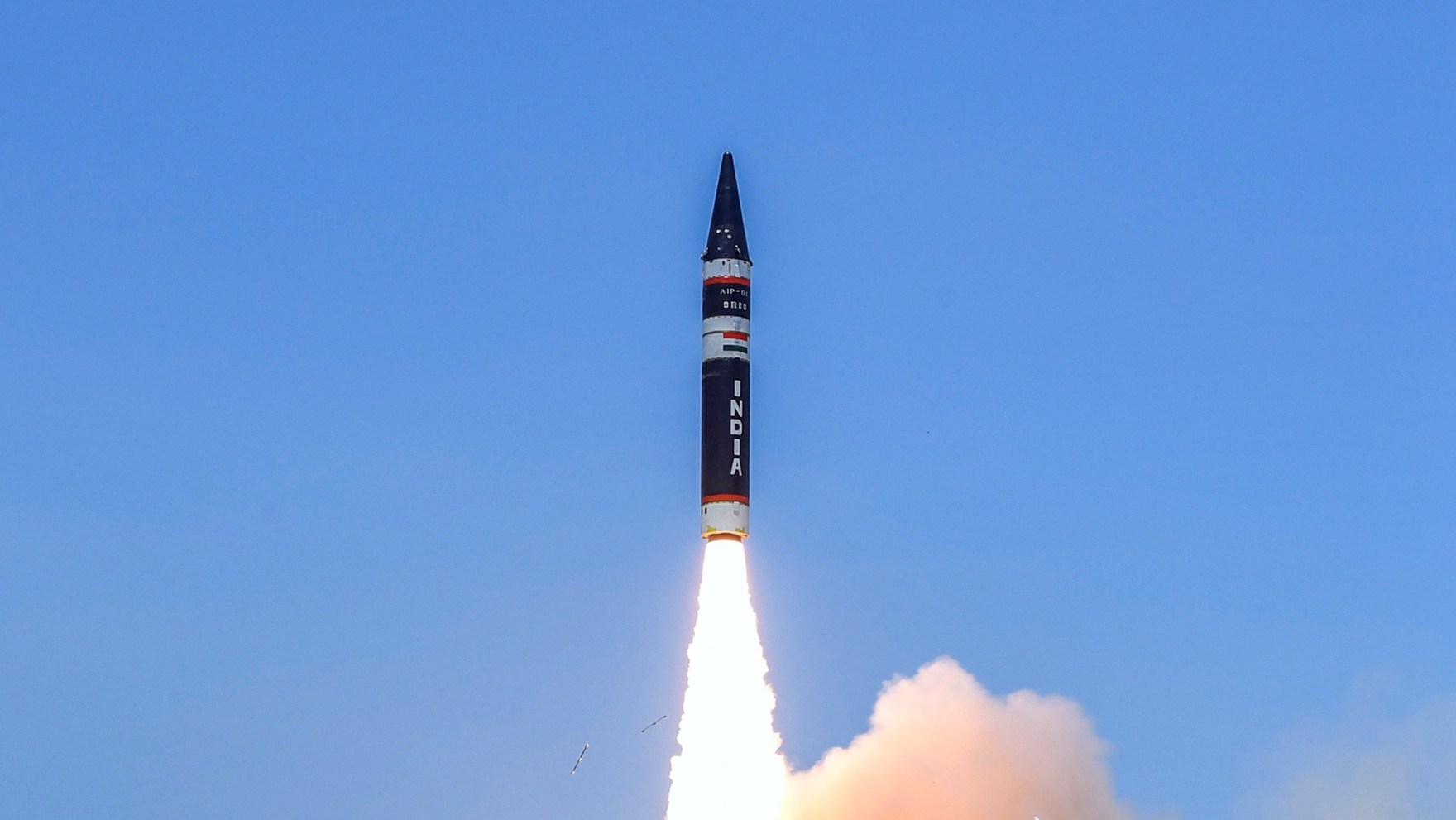
India’s Agni family of ballistic missiles is the backbone of its land-based nuclear deterrent. The newest and most modern member is the Agni-Prime, or Agni-P: a lighter, more accurate and more mobile missile that can be hidden in a sealed canister and, since 2025, fired from a train. Here is what makes it important.
- New-generation, two-stage, solid-fuel medium-range ballistic missile
- Range of 1,000 to 2,000 km
- Canisterised for road-mobile and rail-mobile launch
- First flight test in June 2021; rail-based launch in September 2025
- Developed by DRDO, operated by India’s Strategic Forces Command
What is the Agni-Prime?
The Agni-Prime is a nuclear-capable medium-range ballistic missile developed by India’s Defence Research and Development Organisation (DRDO). It combines technology from the longer-range Agni-IV and Agni-V, including composite rocket motor casings and advanced navigation, in a smaller missile. It is intended to replace the older Agni-I and Agni-II, which are heavier and slower to prepare for launch.
Range and design
The missile has two solid-fuel stages and a range of 1,000 to 2,000 km, enough to cover all of Pakistan and parts of China from Indian territory. Composite materials make it lighter than earlier Agnis, and its improved guidance gives it greater accuracy. Reports also suggest it can carry a manoeuvrable re-entry vehicle, making it harder to intercept.
Why the canister matters
The Agni-Prime is stored and launched from a sealed canister. This protects the missile, reduces maintenance and allows it to be fired quickly from a mobile launcher, with less warning time for an adversary. Mobility makes the missiles harder to find and destroy, which strengthens India’s second-strike capability under its no-first-use nuclear doctrine.
Tests so far
The first flight test took place on 28 June 2021 from Dr APJ Abdul Kalam Island off the coast of Odisha. Several further tests followed, including a night pre-induction launch with the Strategic Forces Command in 2024. In September 2025 DRDO conducted the first launch from a specially designed rail-based mobile launcher, making India one of a small group of countries able to fire a ballistic missile from a train.
Rail-mobile launch
India’s railway network is one of the largest in the world. Rail launchers let missiles move across the country and hide among ordinary traffic and tunnels, much as the Soviet Union once did with its RT-23 Molodets system. The capability adds another layer of survivability to India’s deterrent.
Verdict
The Agni-Prime shows how India is modernising its nuclear forces: lighter missiles, canister launch, better accuracy and more mobility. As it replaces the first-generation Agnis, it will become the main medium-range weapon in India’s arsenal and a key part of its deterrent against both Pakistan and China.
Featured image: Ministry of Defence / GODL-India, via Wikimedia Commons