Burevestnik Missile Explained: Russia’s Nuclear-Powered Cruise Missile, Range and Tests
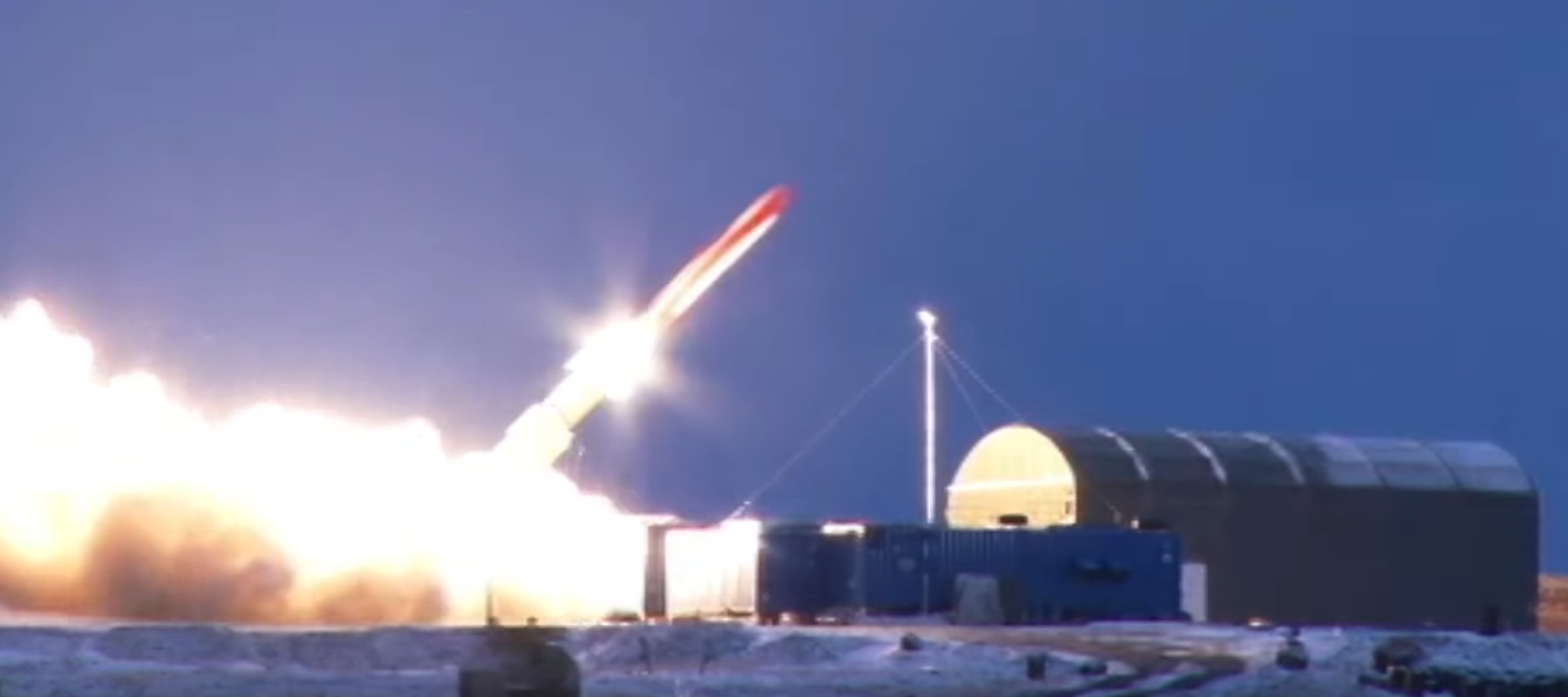
Most cruise missiles fly for an hour or two before their fuel runs out. Russia’s Burevestnik is designed to stay in the air for many hours, possibly days, because it is powered by a small nuclear reactor. Vladimir Putin calls it a weapon with no equivalent in the world. Western analysts call it dangerous, expensive and of questionable military value. Here is what we know.
- Russian designation 9M730 Burevestnik (“Storm Petrel”); NATO name SSC-X-9 Skyfall
- Nuclear-powered, nuclear-armed, ground-launched cruise missile
- Range described by Moscow as practically unlimited
- Russia said a test in October 2025 flew about 14,000 km in roughly 15 hours
- Linked by analysts to the deadly 2019 Nyonoksa radiation accident
What is the Burevestnik?
The Burevestnik was unveiled by Putin on 1 March 2018 alongside other so-called “invincible” weapons such as the Sarmat ICBM, the Kinzhal missile and the Poseidon nuclear torpedo. It is a subsonic cruise missile that carries a nuclear warhead and uses a compact nuclear reactor instead of a conventional jet engine for its main flight phase.
It is launched with a solid-fuel booster. Once airborne, the reactor is meant to heat incoming air, which is then expelled to produce thrust. In theory, that gives the missile almost endless endurance.
How far can the Burevestnik fly?
Moscow has never published an official range, describing it only as unlimited. In October 2025 Chief of the General Staff Valery Gerasimov told Putin that a test on 21 October had flown about 14,000 km and stayed airborne for around 15 hours, and that this was not the limit. Those figures could not be independently verified.
Why would Russia want it?
The idea is to defeat missile defences. A missile with unlimited endurance could fly long, unpredictable routes at low altitude, approaching the United States from directions not covered by radars and interceptors, such as the South Pacific or South Atlantic. Russia presents it as an answer to US missile defence plans, including the Golden Dome programme.
Tests and the Nyonoksa accident
Development has been troubled. US intelligence assessments reported several failed or short tests between 2017 and 2019. On 8 August 2019 an explosion at the Nyonoksa test range on the White Sea killed five Rosatom specialists and caused a brief spike in radiation in nearby Severodvinsk. Russia never fully explained the incident, but many experts believe it was linked to the recovery of a Burevestnik from the seabed.
Open-source researchers later identified a likely deployment site near Vologda, north of Moscow, with launch pads built in the mid-2020s.
Is it a real threat?
Critics point out that the Burevestnik is slow compared with ballistic missiles and could be detected and shot down over a long flight. Its reactor would also scatter radioactive material along its route. The United States studied a similar concept in the 1960s, Project Pluto, and abandoned it as too dangerous. Even so, a weapon that can loiter and approach from any direction complicates defence planning.
Verdict
The Burevestnik is less a battlefield weapon than a political signal: proof that Russia can field exotic strategic systems despite sanctions and war. If it enters service in numbers, it adds another layer to Russia’s nuclear arsenal, but the risks of flying a reactor across the planet remain its biggest weakness.
Featured image: Ministry of Defence of the Russian Federation / CC BY 4.0, via Wikimedia Commons