C-17 Globemaster III: Specs, Payload, Range and Who Flies It
When the US military needs to move tanks, helicopters or thousands of troops across the world in a hurry, it usually calls the C-17 Globemaster III. Few aircraft have done more to shape modern expeditionary warfare and disaster relief. Here are its key specs, abilities and operators.
- Strategic airlifter built by Boeing (originally McDonnell Douglas)
- Maximum payload about 77 tonnes
- Can carry an M1 Abrams tank
- Lands on short, rough runways of about 1,000 m
- 279 built; operated by the US and eight other users
What is the C-17?
The C-17 is a four-engine strategic airlifter developed by McDonnell Douglas, which later merged with Boeing. It first flew in 1991 and entered US Air Force service in 1995. Unlike earlier strategic transports, it was designed to carry outsized cargo over intercontinental distances and still land on short, unprepared airstrips close to the front line.
Key specifications
The C-17 is about 53 metres long with a wingspan of around 52 metres. Four Pratt & Whitney F117 turbofans give it a cruise speed of roughly Mach 0.77. Its maximum payload is about 77 tonnes, enough for an M1 Abrams tank, several Stryker vehicles, or helicopters such as the AH-64 Apache. With a heavy load it can fly around 4,500 kilometres, and much farther with aerial refuelling. It needs only about 1,000 metres of runway, thanks to powerful thrust reversers and high-lift flaps. A crew of just three, two pilots and a loadmaster, operates it.
Airdrop and medevac
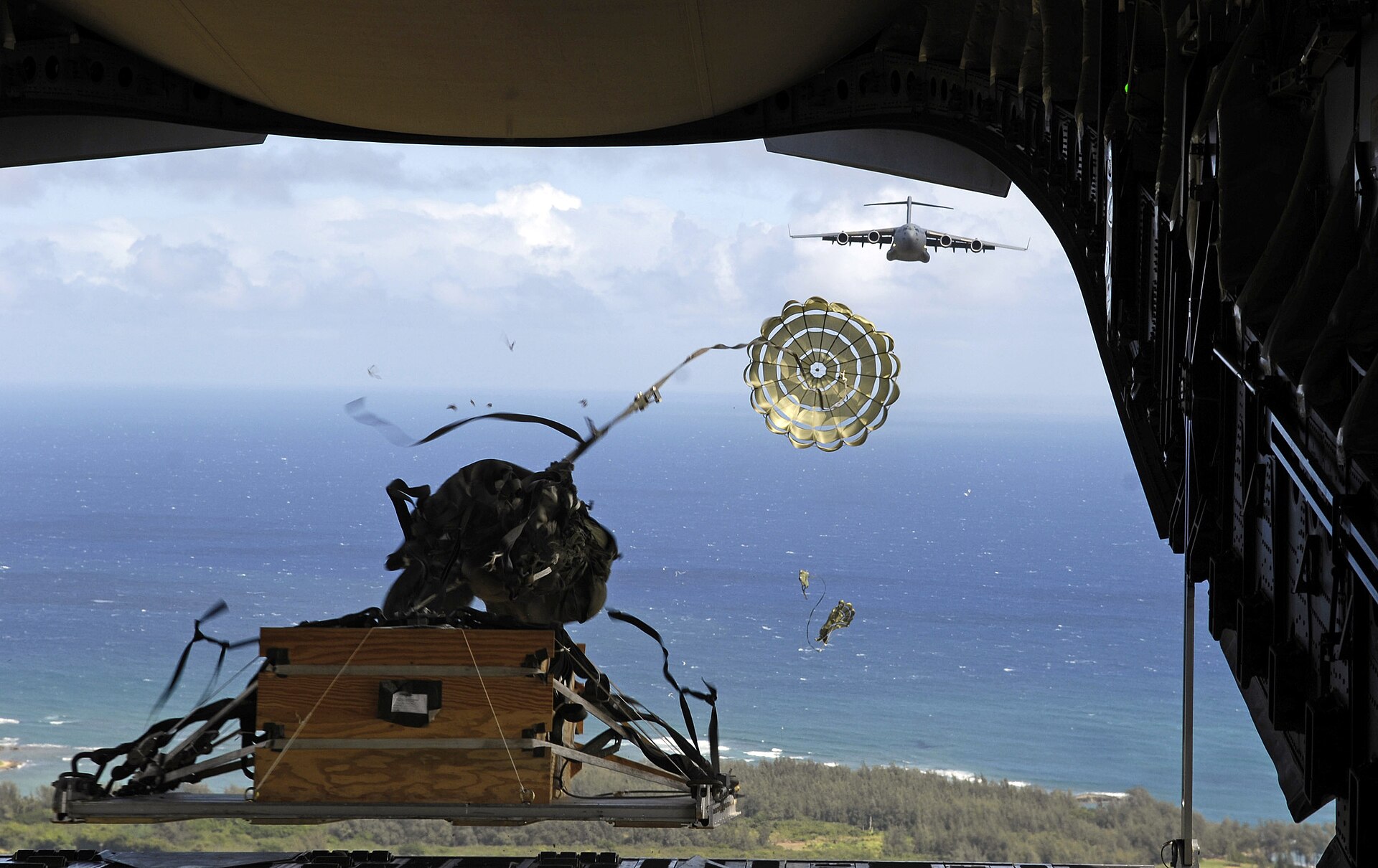
The C-17 can drop paratroopers and heavy equipment, carry around 100 troops or stretcher patients in medical evacuation configuration, and operate as a flying hospital. Its large rear ramp allows vehicles to drive straight on and off.
Famous missions
C-17s have supported every major US operation since the 1990s, from Kosovo and Afghanistan to Iraq. During the 2021 evacuation of Kabul, one C-17 carried more than 800 people in a single flight, an iconic image of the withdrawal. The aircraft also delivered weapons to Ukraine, missile defence systems to the Middle East and aid after earthquakes and hurricanes.
Who flies it?
Boeing built 279 C-17s before the production line closed in 2015. The US Air Force operates the vast majority. International operators include the UK, Australia, Canada, India, Qatar, the United Arab Emirates and Kuwait, plus a NATO-led multinational unit based in Hungary.
What replaces it?
There is no direct replacement yet. The US Air Force is studying a Next-Generation Airlift concept for the 2040s, while the C-17 fleet is being upgraded to stay in service for decades. Smaller transports like the A400M and KC-390 cannot match its payload over long distances.
Verdict
The C-17 is the backbone of global military airlift. Its rare mix of payload, range and short-field performance makes it one of the most important, if least glamorous, aircraft in any modern air force.
Featured image: Tech. Sgt. Shane A. Cuomo / Public domain, via Wikimedia Commons