

Fighter Aircraft
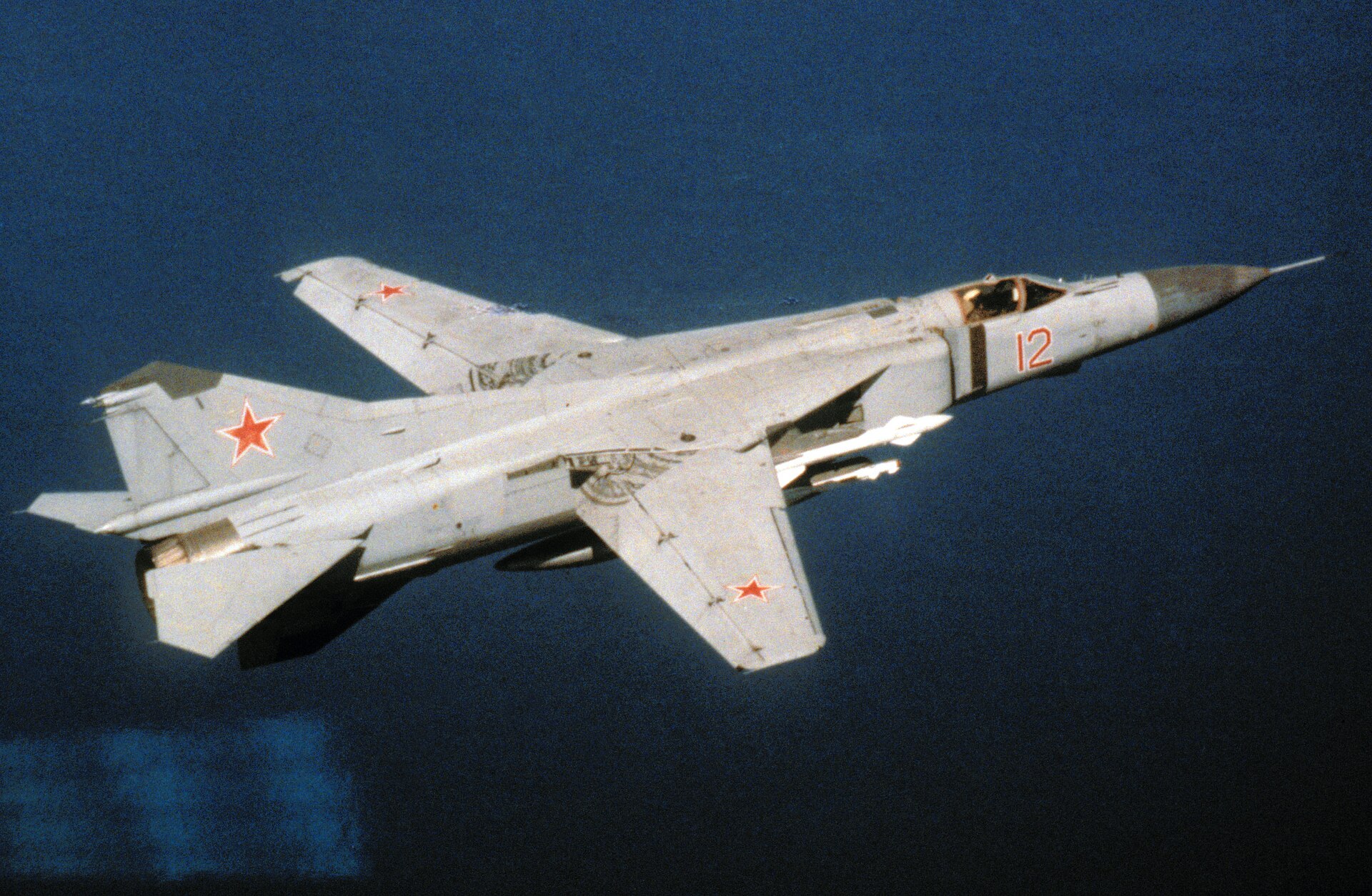
MiG-23 Flogger
The MiG-23 Flogger is a single-engine, variable-geometry fighter built by Mikoyan-Gurevich in the Soviet Union, in service since 1970. It was the first Soviet fighter with look-down/shoot-down radar and was widely exported, though few remain flyable today.
 Russia|Mikoyan-Gurevich
What Is the MiG-23 Flogger? Overview, History and Development
The MiG-23 first flew in June 1967 and entered Soviet service in 1970 as the MiG-23S. It was powered by a Tumansky R-29-300 engine and had swing wings for both speed and short-field performance, reaching about Mach 2.35. It was the first Soviet fighter with a look-down/shoot-down radar, the Sapfir-23, and carried R-23, R-24 and R-60 missiles plus a 23 mm GSh-23L cannon. The MLD version added leading-edge flaps to improve handling.
About 5,047 MiG-23s were built, and around 7,000 when the ground-attack MiG-27 is included. Export MiG-23MS and MiG-23BN versions went to dozens of countries, and Russia retired the type in the 1990s. North Korea, Cuba, Libya and Syria are among the last known users, although counts are uncertain because many airframes are stored or unflyable. It saw combat in the Iran-Iraq War, Lebanon in 1982, Angola, Chad and Syria. Pilots often described it as unforgiving at low speed.
MiG-23 Flogger Specifications: Speed, Range, Engines and Armament
MiG-23 Flogger Variants and Versions Compared
The MiG-23M was the first widely built interceptor version, with the Sapfir-23 radar and R-23 and R-60 missiles.
The MiG-23MLD was the improved late version with leading-edge flaps for better manoeuvrability and an upgraded radar.
The MiG-23BN was an export ground-attack version with a simplified radar and a focus on bombs and rockets.
Which Countries Use the MiG-23 Flogger? Operators and Users
 North Korea
 Cuba
Cuba Libya
Libya Syria
SyriaMiG-23 Flogger FAQ: Price, Range, Operators and Most Asked Questions
How fast is the MiG-23?
The MiG-23 Flogger has a maximum speed of about Mach 2.35. Its variable-geometry wings let it fly fast at altitude while keeping acceptable takeoff and landing performance.
Which countries still use the MiG-23?
North Korea, Cuba, Libya and Syria are among the last known MiG-23 users. Counts are uncertain because many airframes are stored or unflyable, and Syria’s air force was largely destroyed or abandoned after December 2024.
How many MiG-23s were built?
About 5,047 MiG-23 fighters were built, and around 7,000 including the MiG-27 ground-attack family. Production ran at plants in Moscow, Irkutsk and Chkalov.
Was the MiG-23 a good fighter?
The MiG-23 Flogger was a capable interceptor for its time, as the first Soviet fighter with look-down/shoot-down radar. It was also difficult to fly and unforgiving at low speed, and later fighters such as the F-16 outclassed it.
MiG-23 vs F-4 Phantom: which is better?
The MiG-23 was lighter and cheaper, with a newer radar design, while the F-4 Phantom II carried a heavier load and a second crew member. Results depended on pilot training and the versions involved, and the MiG-23 was often the export model.
Which Arab countries used the MiG-23?
Egypt, Iraq, Syria, Libya and Algeria were major MiG-23 operators between the 1970s and 1990s. Syria and Libya are the most likely to retain small numbers today, though their condition is uncertain.